

P3 Conservation Collaboratory
People • Planet • Partnerships
P3 Conservation Collaboratory
At Texas A&M AgriLife, the P3 Conservation Collaboratory (P3CC) is redefining how conservation science is done. We bring together world-class researchers, community leaders, and global partners to tackle today’s most urgent challenges — from biodiversity loss and climate change to sustainable development. Our mission is simple: connect science with society. By working hand in hand with communities, policymakers, and international networks, we generate solutions that protect species, restore ecosystems, and empower people.
👉 Explore our projects.
👉 Meet our partners.
👉 Join us in building a sustainable future.
Learn more about the collaboratory
The P3 Conservation Collaboratory (P3CC) is an interdisciplinary hub at Texas A&M AgriLife dedicated to advancing conservation through science, education, and collaboration.
Founded on the belief that conservation is most effective when people are at the center, P3CC integrates ecological research with social innovation. Our faculty, fellows, and students work across Texas and around the world to co-create solutions with communities, Indigenous peoples, and governments.
We partner with leading organizations such as Re:wild, the IUCN Red List, the Borlaug Institute, and the Hagler Institute for Advanced Study to ensure that our work not only informs science but also shapes practice and policy at global scales.
What makes us different?
- A focus on interdisciplinary research — linking ecology, health, and social sciences.
- A commitment to equity and inclusion, amplifying the voices of historically marginalized communities.
- A network of global partnerships that connects Texas A&M to conservation action worldwide.

Click the image for PPT/Video.
At P3CC, our work is driven by three pillars:
🌱 Biodiversity & Ecosystem Restoration
We protect threatened species and restore critical habitats. From primate rewilding in Cameroon to pollinator conservation in Texas, our projects blend cutting-edge science with local stewardship.
🤝 Community Engagement & Equity
Conservation must benefit people as well as nature. We co-design initiatives with women, youth, and Indigenous peoples, ensuring communities are empowered as leaders in sustainable resource management.
🔬 Innovation & Global Collaboration
We harness technology — from AI-powered monitoring tools to climate-smart agriculture — and link our work to international frameworks like the IUCN Red List and the UN Sustainable Development Goals.
Together, these pillars allow us to translate research into real-world impact, shaping a future where people and planet thrive.
Get Involved / Support Us
At the P3 Conservation Collaboratory (P3CC), we believe that lasting conservation requires partnerships. Whether you’re a student, researcher, donor, or community leader, there are meaningful ways to join our mission.
🎓 For Students & Scholars
- Apply for research and training opportunities with P3CC.
- Join interdisciplinary teams working on projects from Texas to the Congo Basin.
- Connect with global networks like the Fulbright Program and the Hagler Institute for Advanced Study through our partnerships.
🌍 For Communities & Partners
- Collaborate with us to co-design conservation and sustainability solutions.
- Tap into our expertise on biodiversity, climate resilience, and sustainable development.
- Share your voice — we integrate local and Indigenous knowledge into every project.
💝 For Donors & Supporters
Your support fuels innovation and impact. Contributions help us:
- Train the next generation of conservation leaders.
- Protect endangered species and restore fragile ecosystems.
- Expand global partnerships that turn science into action.
👉 Partner with us to make a difference.
Together, we can build a world where people and planet thrive in harmony.
Texas A&M AgriLife Research and the University of Seoul Sign Memorandum of Understanding
Texas A&M AgriLife Research and the University of Seoul (UoS) are pleased to announce the signing of a Memorandum of Understanding (MOU), effective September 2025. This agreement formalizes a collaborative partnership between Texas A&M AgriLife Research—an agency of the State of Texas and a member of The Texas A&M University System—and the University of Seoul.
The MOU establishes a framework for exploring opportunities of mutual interest across a range of priority areas, including conservation biology, biodiversity surveys, threatened species assessment and monitoring, conservation policy and action, and the application of ecological and applied biodiversity science to the conservation of natural resources.
Through this partnership, both institutions aim to foster faculty collaboration, joint research initiatives, academic exchange, and capacity building that advance science-based conservation and natural resource education. The P3 Conservation Collaboratory looks forward to supporting and facilitating these collaborative efforts and to strengthening international partnerships that contribute meaningfully to global biodiversity conservation.
Contact:
Taeyoon Lee, Ph.D.
Instructional Assistant Professor
Department of Ecology and Conservation Biology
Texas A&M University
2258 TAMU, 534 John Kimbrough BLVD,
College Station, TX 77843-2258, USA
Email: [email protected]

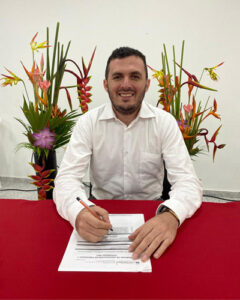
We are happy to welcome Dr. Héctor Eduardo Hernández Núñez, Professor in the Doctorado en Ciencias Naturales y Desarrollo Sustentable at Universidad de la Amazonia (Colombia), for a 3 months exchange visit to Texas A&M University (September to November 2025).
Dr. Hernández is expected to collaborate on the assessment of ecosystem services in coffee- and cacao-based agroforestry systems in the Colombian Amazon. Some of his planned activities include:
- Promoting collaboration on methodologies for agroforestry analysis (field design, indicators, data workflows, and decision tools)
- Advancing the agroecological transition of rural farms through participatory, evidence-based approaches
- Exploring joint proposals, student mentorship, and comparative case studies across tropical landscapes
His time will be shared between the Department of Ecology and Conservation Biology (ECCB) and the Center for Coffee Research & Education (or AGLS), but we have given him a workspace in WFES 336 (P3 Conservation Collaboratory)
Dr. Héctor Eduardo Hernández Núñez is an Agroecological Engineer, holds a MS degree in Sustainable Production Systems, and a Ph.D. in Agricultural Sciences. He is a faculty member in Natural Sciences and Sustainable Development and the Coordinator of the Master’s in Biostatistics at the University of the Amazon in Colombia. His research focuses on the study of agroforestry systems with cocoa and coffee as strategies for sustainable rural development. From an agroecological approach, he has analyzed the interactions between vegetation structure, ecological functionality, and productive performance, as well as the relationships between local knowledge, community capitals, and the well-being of rural households. His studies, mainly conducted in the departments of Caquetá, Meta, Guaviare, and Huila, provide evidence of how livelihood management influences resilience to climate change and local development. Eduardo has promoted the articulation between science and territory through participatory approaches, integrating statistical and social methods to understand processes of adaptation, food self-sufficiency, and the strengthening of rural capacities. His results, published in international journals such as Journal of Rural Studies, Agroforestry Systems, Agriculture and Human Values, Land Use Policy, and Human Ecology, among others, contribute to consolidating a scientific basis for the sustainable development of the Colombian Amazon.

P3 Conservation Collaboratory Hosts Fulbright African Research Scholar, Dr. Taiye Aderniyi Adeyanju
From January 14 to June 14, 2025, the P3 Conservation Collaboratory had the honor of hosting Fulbright African Research Scholar, Dr. Taiye Aderniyi Adeyanju, as he undertook an academic development residency at Texas A&M University.
Under the supervision of Dr. Katy Gonder, Head of the Department of Ecology and Conservation Biology (ECCB), and in collaboration with administrative staff, faculty, and students, Dr. Adeyanju focused his work on strengthening the undergraduate curriculum of the Department of Wildlife and Ecotourism Management (WEM) at the University of Ibadan, Nigeria. His project aimed to assess the rigor, relevance, and competitive standing of WEM’s curriculum by benchmarking against the degree structures, course offerings, and pedagogical approaches used at TAMU.
During his tenure, Dr. Adeyanju conducted a comprehensive situational analysis comparing WEM’s curriculum with those of ECCB and related programs, including Rangeland, Wildlife, and Fisheries Management, and Recreation, Park, and Tourism Sciences. He evaluated alignment with international accreditation standards for Bachelor’s programs in Wildlife Management, Ecotourism, and Ecology. His review identified outdated or redundant modules and highlighted structural gaps, which he categorized into strengths, weaknesses, and opportunities for enhancement. His proposed abridged curriculum has been formally submitted to the University of Ibadan for consideration and further action toward modernization of the WEM program.
Beyond curriculum development, Dr. Adeyanju actively contributed to conservation networking, participating in virtual stakeholder engagements aimed at updating knowledge on the Nigeria-Cameroon chimpanzee, a priority initiative led by Dr. Gonder. His contributions supported the development of a registry of current actors, identification of research capacity gaps, and planning for a 2026 stakeholder workshop. He also assisted in outlining next steps for field reassessments of chimpanzee habitat sites in Nigeria. These contributions underscore meaningful progress toward addressing urgent research and conservation needs for this endangered subspecies.
Upon returning to Nigeria, Dr. Adeyanju has continued engaging WEM faculty in a participatory process to define learning outcomes, employer expectations, and workforce skills essential for the next generation of professionals. This ongoing effort involves both local and international stakeholders and aims to ensure that the WEM curriculum evolves in step with the rapidly advancing fields of wildlife and ecotourism management.
Looking forward, Dr. Adeyanju plans to convene a collaborative curriculum development workshop involving academic experts, industry partners, and conservation stakeholders to produce a structured roadmap for strengthening WEM training and career preparation.
Dr. Adeyanju is a passionate wildlife ecologist with deep research interests in birds and bats, particularly within human-modified landscapes. His leadership experience includes serving as Sub-Dean of the Faculty of Agriculture and Forestry (2017–2018) and Sub-Dean of the Faculty of Renewable Natural Resources (2018–2022) at the University of Ibadan. He is currently the Bat Sampling Coordinator for the WAC-EID Nigeria Centre. He holds a B.Sc. in Biology (Ahmadu Bello University), an M.Sc. in Conservation Biology (APLORI–University of Jos), and a Ph.D. in Wildlife Management (University of Ibadan).
The P3 Conservation Collaboratory extends its appreciation to Dr. Adeyanju for his significant contributions and looks forward to continued collaboration that strengthens conservation education across Africa.
About the Prize
Categories: Graduate, Undergraduate, Community Leader
Nomination Guidelines
Past Awardees Gallery
Upcoming Award Deadlines and Ceremony Info
Overview of how ABS priorities are embedded in ECCB courses
List of aligned undergraduate and graduate courses
ABS Field Schools and Capstone Projects
Student testimonials
Link to course registration

Dr. Kevin Y. Njabo Senior Research Scientist
Department of Ecology and Conservation Biology
Program Coordinator, Applied Biodiversity Science (ABS)
Director, P3 Conservation Collaboratory; President CTR-Cameroon
Texas A&M University
Emil: [email protected]
Kevin is a Senior Research Scientist at Texas A&M University, where he also serves as Program Coordinator for the Applied Biodiversity Science (ABS) program and Director of the P3 Conservation Collaboratory. In these roles, he oversees interdisciplinary research projects, mentors emerging scientists, and fosters a culture of innovation and sustainability.
Through the P3 Conservation Collaboratory, he works to advance a bold vision for the future of conservation science, one that bridges research, policy, and practice. Rooted in Texas A&M AgriLife’s tradition of leadership and global impact, the Collaboratory convenes scientists, students, and communities across continents to address urgent challenges including deforestation, climate change, species extinction, and ecosystem collapse.
Prior to joining Texas A&M, he was Africa Director at the Center for Tropical Research and an Associate Professor at the University of California, Los Angeles (UCLA), where he held appointments at both the Institute of the Environment and Sustainability and the Department of Environmental Health Sciences. His leadership spanned major environmental and public health initiatives across Africa, while contributing to academic discourse through teaching, research, and international partnerships.
With more than 20 years of experience across environmental sciences, healthcare, and public health, he brings expertise in biodiversity conservation, environmental health sciences, policy, education, and sustainable development. He has taught at the National University of Rwanda and the International Bilingual Academy in Yaoundé, Cameroon, focusing on biodiversity conservation, ecotourism, and environmental impact assessment.
He is deeply engaged in professional service and leadership, having served as a Board Member of the Society for Conservation Biology and Council Member of the Pan African Ornithological Congress Committee. He helps oversee the Ganga Field Station in Cameroon and a member of the Organization of Biological Field Stations (OFBS),
Currently, he is leading Rewild Mbalmayo, a science-based, community-centered initiative to restore ecological integrity, rebuild wildlife populations, and enhance community resilience in Cameroon. Anchored in Texas A&M’s Department of Ecology and Conservation Biology, this flagship project aims to transform the Mbalmayo Forest Reserve into a replicable model for climate-smart reforestation, biodiversity recovery, and rural revitalization.

Katy Gonder
Professor & Department Head
Department of Ecology and Conservation Biology
Texas A&M University
Email: [email protected]
Dr. Gonder holds the position of professor and department head in the field of Ecology and Conservation Biology at Texas A&M University. Her primary research centers on investigating the biological history of the Gulf of Guinea and Congo Basin rainforests, crucial hubs of global biological diversity. Dr. Gonder’s ongoing research encompasses three main areas of focus:
- Analyzing spatial biodiversity patterns.
- Unraveling the underlying evolutionary and ecological mechanisms contributing to diversity.
- Contributing to conservation strategies that incorporate both evolutionary patterns and processes.
Although her earlier work predominantly concentrated on primates, particularly chimpanzees, her research scope is not limited to a specific taxonomic group. Her research group is currently engaged in studying various tropical vertebrates with the explicit goal of enhancing biodiversity forecasting and conservation planning.
Having dedicated nearly three decades to central Africa, primarily in Cameroon and Nigeria, Dr. Gonder has also extended her research to Gabon and Equatorial Guinea. She has co-hosted several international technical workshops in this region and holds of the IUCN’s Primate Specialist Group’s Great Apes section and the IUCN Marine Turtle Specialist Group. Additionally, she is one of the six scientists on the Scientific Commission of the United Nations Great Ape Survival Project.
Featured peer-reviewed publications, policy briefs, and reports
Filters by:
Region (Africa, Latin America, Texas);
Theme (Climate, Biodiversity, Food Security)
Author
Search bar
Downloadable PDFs and citation formats
DOI links and Altmetric badges
Highlighted “Student-Led Research” section
We were honored to welcome Dr. Andrea Allen, Professor of Criminal Justice at Clayton State University, as a guest lecturer in Dr. Kevin Njabo’s Wildlife Forensic class. Dr. Andrea A. presented “When Wildlife and CSI Collide: Animal Bones, Human Forensics, and 3D Innovation” exploring the intersection of wildlife forensic science and 3D printing technology.
In her latest blog post, Dr. Allen reflects on expanding 3D printing applications from wildlife forensics to broader impacts, including conservation education and assistive devices. Her work exemplifies how technology can bridge disciplines and create real-world solutions.

For Students: Internships, research assistantships
For NGOs: Co-design a project
For Donors: Give to P3CC (link to TAMU Foundation)
Volunteer opportunities
Newsletter sign-up form
Contact form (with topic dropdown: Partnerships, Media, Fellowship, Prize)
Address, phone, email
Google Map location
Staff contacts for program inquiries